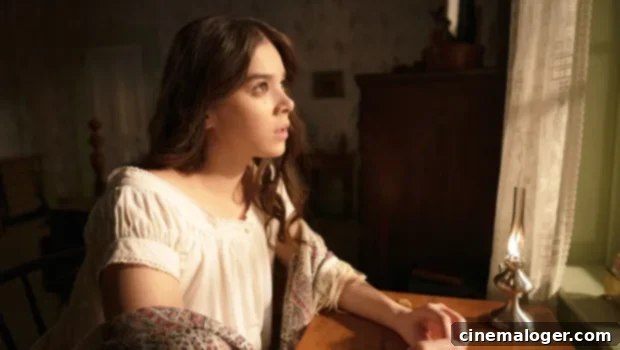
Dickinson Season 2 Review: Hailee Steinfeld Dazzles in Emily’s Journey for Fame on Apple TV+
My introduction to Dickinson was, admittedly, a late one, unfolding during a recent holiday quarantine. Yet, in that brief window, this Apple TV+ original series captivated me entirely. What began as a casual watch quickly spiraled into a full-blown obsession; I devoured the entire first season in a single day, only to rewatch it the very next. Certain episodes, particularly the poignant ‘Wild Nights’ and the thought-provoking ‘We Lose – Because We Win,’ commanded multiple repeat viewings. This rapid immersion made me profoundly grateful for my delayed discovery, as I can scarcely imagine enduring the anticipation for Season Two, which finally graced screens on January 8th.
For those yet to embark on this unique journey, Dickinson is far from a conventional period drama. Crafted by the visionary playwright Alena Smith and starring the exceptionally talented Hailee Steinfeld as the titular Emily Dickinson, the series offers a radical, anachronistic, and deeply empathetic exploration of the American poet’s formative years. Forget any preconceptions of a dry, historical biography; Dickinson thrives on its vibrant energy, a compelling blend of fact and poetic license that resonates whether you’re a lifelong admirer of Dickinson’s verse or a newcomer to her world. Indeed, the show itself might just spark that admiration.
At its core, Dickinson is a modernized fable about a woman profoundly ahead of her time, whose genius largely remained hidden from the world during her lifetime. While the characters and foundational plot points are rooted in historical fact, Smith, alongside Steinfeld (who also serves as an executive producer), ingeniously uses Emily’s poetry as a springboard. This approach allows them to craft an immersive, often hilarious, and undeniably sexy interpretation of her life. The series masterfully walks a delicate tightrope, blending authentic 1850s costumes and settings with contemporary language, music, and attitudes. It’s a visually stunning and audibly captivating experience that feels both historically grounded and thrillingly current.
The series is celebrated for its sharp wit and experimental narrative, but it’s the sheer unpredictability that truly sets Dickinson apart. With Season Two, the stakes and the artistic ambition are elevated to an entirely new echelon. The ensemble cast is nothing short of exceptional, anchored by Hailee Steinfeld’s extraordinary portrayal of Emily. Steinfeld navigates Emily’s complex emotional landscape with astonishing grace, seamlessly transitioning from moments of charismatic defiance to those of crushing sadness and vulnerability. Her performance is a central pillar, conveying the poet’s internal world with profound depth.
Beyond Steinfeld, the show is brought to vivid life by a captivating cohort of young talent. Adrian Blake Enscoe delivers a quiet, yet powerful performance as Austin Dickinson, often stealing scenes with subtle intensity. Anna Baryshnikov is the comedic heartbeat of the series, infusing Lavinia Dickinson with an infectious energy and brilliant timing. And then there is Ella Hunt, whose incredibly layered and nuanced portrayal of Sue Gilbert truly demands widespread recognition; her performance this season is a masterclass in emotional complexity.
Season Two picks up many months after the emotionally charged climax of the first season. Emily, still reeling from witnessing her best friend and secret love, Sue (Ella Hunt), marry her brother Austin (Adrian Blake Enscoe) and quite literally embark on their married life together. Simultaneously, Emily made a powerful stand against her father, Edward Dickinson, asserting her identity as a writer and vowing to fight for the publication of her work. Thus, we find her at the dawn of Season Two on the precipice of profound change, grappling with newfound aspirations and complicated emotions. The initial three episodes immediately plunge us into her evolving world, setting the tone for a season defined by artistic ambition and personal turmoil.
Episode One Recap : Before I got my eye put out
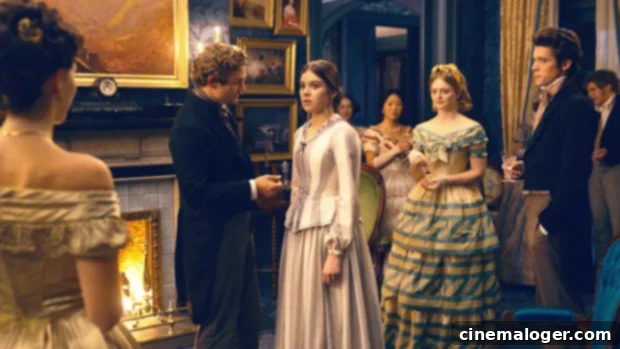
The second season opens in 1859, revealing Emily Dickinson grappling with the nascent stages of a lifelong affliction related to her eyesight. Beyond a heightened sensitivity to light and encroaching blurriness, she begins to experience unsettling visions: specifically, a mysterious figure, a personification of her poem “I’m Nobody! Who are you?”, whom she simply dubs ‘Nobody’ (portrayed by Will Pullen). This spectral presence serves as an early harbinger of her internal struggles and the external pressures she faces.
Significant transformations are evident within the Dickinson household, particularly concerning the siblings. As Emily dedicates herself tirelessly to her writing, often defying doctor’s warnings about the strain on her eyes, her sister Lavinia (Anna Baryshnikov) finds herself unexpectedly courted. The new family boarder, Henry “Ship” Shipley (Pico Alexander), an old college friend of Austin’s, quickly declares his intention to marry her, describing her as “the most pure, simple, quiet, traditional girl I ever knew.” Ship’s conventional expectations are swiftly challenged as he discovers the true, vivacious Lavinia, a revelation that begins with a memorable trip to her bedchamber, underscoring the show’s comedic and modern sensibilities.
Meanwhile, much has changed for the Dickinson siblings. Austin’s lavish new home, ‘The Evergreens,’ has become a buzzing social hub, its reputation spreading throughout New England thanks to the extravagant parties hosted by his young wife. Indeed, few characters have undergone as dramatic a metamorphosis as Sue. She presents herself as impeccably dressed, a diligent social climber, and strikingly, not a new mother, subtly hinting at the unspoken pain of her recent miscarriage. When Emily, ink-stained from her passionate writing, arrives at Sue’s salon, Sue gently escorts her to the library to clean her up. In this intimate setting, Emily presses her muse about the secret poems she has written for her. Sue confesses her profound love for the verses, acknowledging how deeply they move her, but also how they stir painful emotions she wishes to suppress, particularly the grief of losing her child. Emily offers comfort, and the moment becomes charged with an unspoken tenderness, a testament to their inhibited love affair, now complicated by Sue’s marriage to Austin. However, Sue quickly pulls away, revealing that the lavish party was orchestrated primarily for Emily, with the aim of introducing her to someone who could profoundly alter her life’s trajectory.
This brings us to the charismatic Sam Bowles, masterfully played by the dashing Finn Jones. Historically, Sam Bowles, the influential editor of the Springfield Republican, was a genuine acquaintance of the Dickinson family. His introduction in Season Two is designed to propel Emily towards the intoxicating, yet perilous, path of fame. Sue appears particularly eager to assist her sister-in-law in getting published. She ushers Emily back into the parlor, urging her to recite one of her poems for Sam and the assembled guests. It is here that Emily again encounters the enigmatic ‘Nobody,’ and a wave of fear washes over her. She retreats, but not before casting a lingering glance at Sam, who seems more intrigued by her unconventional nature than ever, signaling a complex relationship dynamic to unfold.
Episode Two Recap: Fame is a fickle food
The second episode, titled ‘Fame is a fickle food,’ encapsulates the central dilemma of Season Two: Emily’s profound internal conflict regarding the pursuit of fame. Her father, Edward, has historically been adamantly against her publishing her work, a stance that has long constrained Emily. Conversely, Sue, now a force of modern ambition, almost demands that Emily allow her extraordinary work to be recognized by the world. This push and pull creates significant tension, forcing Emily to confront her deepest desires and fears about visibility.
Yet, Emily’s interests are not solely confined to the literary realm, a fact delightfully showcased during the annual Amherst Cattle Show. Driven by a surprising domestic competitive streak, Emily sets her sights on winning the baking competition – yes, our girl has a domestic side after all. She pours her artistic passion into a decadent, sky-high chocolate cake, proving that her genius extends beyond poetry. (A notable, and infectious, detail from this scene is the vibrant track ‘Make That Cake’ by Doja Cat, a testament to the show’s curated anachronistic soundtrack that enhances its modern feel).
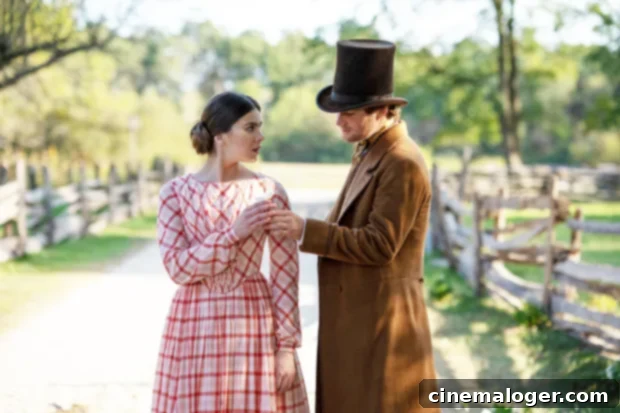
Emily’s culinary triumph is met with an unexpected guest: Sam Bowles, who is quick to congratulate her. He announces that her name and winning recipe will be featured in his paper the following day, a small taste of the public recognition Emily both craves and fears. Her moment of satisfaction is briefly interrupted by another fleeting appearance of ‘Nobody’ in the crowd, a persistent reminder of her internal conflicts. As the Dickinson family heads home to celebrate, a pall is cast over the festivities by Sue, who, perhaps inadvertently, kills the celebratory mood. She dismisses Emily’s achievement, calling it ‘absurd’ that she might be remembered as a baker rather than a poet. Hurt and disheartened, Emily retreats from the house, only to encounter Sam again in the yard. They embark on a stroll, all under the watchful, oddly pleased gaze of Sue from a window, hinting at her manipulative machinations.
Sue’s behavior throughout the episode is indeed perplexing, though perhaps she is still unsettled by a difficult conversation she recently had with Austin back at the Cattle Show. In a rare moment of vulnerability, Austin confesses his desire for them to start a family. Unaware of Sue’s recent miscarriage, he inadvertently inflicts deep emotional pain. Sue reacts with anger, reminding him of his promise not to marry her solely for the purpose of having children, underscoring the fissures in their marriage.
Meanwhile, back at The Evergreens, Austin is seen covertly providing money to Henry (Chinaza Uche), who has been secretly hosting meetings in the family barn with other freed Black slaves. This is a remarkably bold and perilous undertaking, particularly given the family’s precarious financial situation. Earlier that morning, Edward Dickinson (Toby Huss) revealed to Austin that the family is in serious debt, though he outlined a plan to bring in new funds. By the close of the day, Mr. Dickinson returns home with his two orphaned nieces, bringing not only their substantial inheritance but also their even more substantial and challenging attitudes.
Emily, meanwhile, continues her stroll through town with Sam, finding herself increasingly captivated by his charm and intellect, even after discovering he is a married man. Sam persistently probes Emily about how she wishes to be remembered. Finally, letting down her guard, Emily spontaneously recites a poem for him. He responds with a compelling compliment, asserting that her poetry far surpasses her baking, a subtle nudge towards her true calling.
Pleased by his affirmation, Emily returns home, only to once again confront ‘Nobody,’ who this time delivers a chilling warning: “You shouldn’t be known. Do not seek fame. Do not trust others who would seek it for you.” This admonition adds a layer of supernatural dread to Emily’s ambition, suggesting a hidden cost to her desire for recognition.
Episode Three Recap: The only Ghost I ever saw
The third episode truly embodies the show’s distinctive blend of humor and the bizarre, creating a comedic masterpiece that perfectly showcases its experimental spirit. This installment is a tour de force for Anna Baryshnikov and, especially, Jane Krakowski, whose incomparable portrayal of Emily’s mother, Mrs. Dickinson, finally takes center stage. Throughout the series, Mrs. Dickinson’s unwavering focus on being the perfect housewife and her intense preoccupation with her children’s romantic lives have delivered some of the show’s most hilariously deadpan one-liners. Here, Jane Krakowski expands her comedic range, delving into brilliant physical comedy.
With her daughters immersed in their own intricate lives and her husband absorbed by his work, Mrs. Dickinson seeks solace and distraction in lavish baths and the daily news. She becomes particularly engrossed in the tragic account of a horrible shipwreck, its sad details filling the newspaper pages. One glimpse of the charismatic Captain Thomas Taylor, presumed lost at sea, and Mrs. Dickinson is utterly smitten. Maggie, the family maid, playfully suggests that Mrs. Dickinson should listen for telepathic messages from the distressed Captain, whose body was never recovered, perhaps a plea for rescue. As wild as this notion might sound, it perfectly sets the stage for the unfolding events.
Indeed, the possibility of supernatural communication is very much in the air, as Emily and Lavinia are preparing to host a séance in the parlor. For Emily, this is an opportunity to consult the spirits for guidance on her publishing dilemma, particularly since her confidante, Sue, has become increasingly unreliable and evasive. (At this point, it becomes genuinely challenging for the audience to remain sympathetic to Sue, given her actions and lack of clear support for Emily).
Meanwhile, Lavinia is determined to disabuse Ship of his illusion that she will be the prim, proper, and obedient wife he envisions. She is utterly obsessed with embodying the spirit of his past love, the scandalous Lola Montez – a desire highlighted by perfectly chosen, sexy guitar music underscoring her ambition. Lola Montez was a vibrant, wild actress from Nevada whom Ship once adored, a woman so audacious she reportedly shot him with a gun! Lavinia’s goal is to learn from the spirits precisely how to transform herself into such an uninhibited figure.
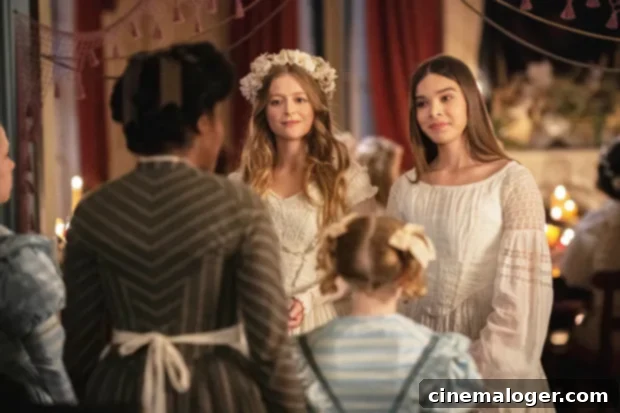
As night descends, Jane and her ‘Gang’ – a truly spectacular quartet of secondary characters who bring their own unique flavor to the series – arrive at the Dickinson home. They are closely followed by Sue’s maid, Hattie (Ayo Edebiri), a familiar and essential presence at the girls’ previous séances. Emily, ever the “classic Sagittarius,” implores the spirits for a clear answer regarding her publishing predicament. Lavinia, in turn, seeks reassurance for her unconventional views on monogamy and guidance on how to fully embrace her inner Lola Montez, again accompanied by that suggestive guitar music. And then, the proceedings take a decidedly strange and chaotic turn.
Upstairs, Mrs. Dickinson reclines by the fire, while Edward snores loudly from his bed. A sudden breeze sweeps through the room, drawing Mrs. Dickinson’s thoughts back to the shipwrecked captain. Suddenly, faint music and a strong male voice singing drift from the distance. Convinced this must be the Captain, she cries out to him, urging him to send his location: his latitude…his loooongitude. In a moment of pure comedic genius, Mrs. Dickinson succumbs to a wildly raucous, overtly sexual fantasy with a ghost, mere feet away from her slumbering husband. It’s an uproarious scene, showcasing Jane Krakowski’s fearless and brilliant comedic timing; who knew she could, erm, work a pole like that, even in a spectral context?!
The downstairs scene is equally, if not more, chaotic. A palpable, strange energy permeates the room, leading to genuine spookiness. Lavinia’s deceased cat is heard growling from beyond the veil; family instruments begin to levitate and fly through the air; Jane’s Gang becomes possessed by unseen forces; Hattie’s eyes roll back in her head in a chilling display. As their séance table rises into the air, all the candles simultaneously extinguish, plunging the room into absolute darkness, heightening the tension and surreal atmosphere.
Frantic in the darkness, Emily instinctively searches for matches in the kitchen. Instead of finding light, she encounters ‘Nobody,’ but his appearance is drastically altered. Drenched in sweat, he recites one of her poems to her, a moment of profound connection, before being abruptly shot in the chest by an unseen gun and collapsing to the floor. Emily watches as her poem slips from his grasp, landing softly beside him. The encounter is vivid, terrifying, and deeply symbolic.
Was it all real, or merely a vivid dream? The brilliance of Dickinson lies in the fact that this question is neither asked nor answered, allowing the audience to ponder the blurred lines between reality and the supernatural, between imagination and manifestation. The next morning, Emily, still shaken, rushes to Sue’s house to recount everything. She finally reveals the existence of ‘Nobody,’ describing him as a demon attempting to thwart her pursuit of fame. But in that moment of revelation, she also confesses her newfound conviction: she unequivocally wants to be remembered. Fortuitously, Sue ushers her into the parlor, where Sam Bowles is waiting. With a surge of confidence, Emily presents her most cherished creation – the very poem that slipped from ‘Nobody’s’ hand – to Sam.
Sam takes the poem from her, seemingly pleased, but then casually tosses it onto a nearby chair, unread. He remarks that it will join the top of his pile with other submissions for consideration. In that instant, Emily’s burgeoning confidence shatters, replaced by a profound wave of regret. The casual dismissal of her most vulnerable offering, the prize embodying her defiance of ‘Nobody’s’ warning, underscores the harsh realities of seeking public validation and the often-unfeeling nature of the world beyond her protective inner circle. This poignant moment sets a compelling trajectory for the remainder of the season.
Dickinson Season 2 premiered its first three episodes on Friday, January 8, exclusively on Apple TV+. New episodes are released weekly on Fridays thereafter, continuing the compelling journey of Emily Dickinson.