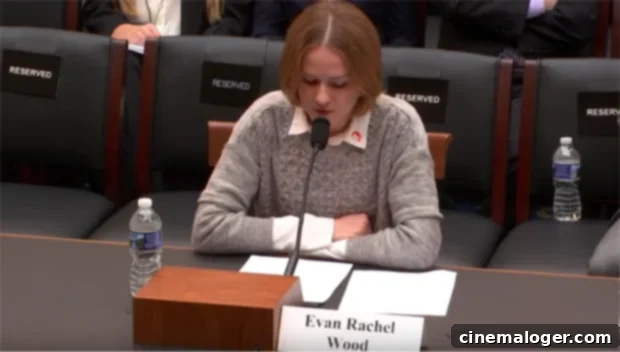
Evan Rachel Wood’s Courageous Testimony: Advocating for Sexual Assault Survivors’ Rights Nationwide
In a powerful and deeply moving address to the U.S. House Judiciary Committee on February 27, actress Evan Rachel Wood delivered a chillingly candid confession, detailing her harrowing experiences with sexual assault and domestic violence. Her testimony was a profound act of bravery, aimed at galvanizing support for the nationwide passage of the Sexual Assault Survivor’s Bill of Rights Act. Wood, celebrated for her roles in productions like Westworld, transcended her public persona to become a resonant voice for countless survivors, sharing the intimate and painful details of two separate incidents that have left an indelible mark on her life.
The 30-year-old bravely recounted a past marred by violence, describing the traumatic events as “burned into my brain and branded there for life. A mental scar that I feel every day.” These incidents included abuse by a former boyfriend and a horrifying assault in a locked closet after hours at a bar. Her decision to come forward and share these deeply personal narratives before a congressional committee underscores not only her individual courage but also the urgent need for systemic change in how the legal system supports survivors of sexual violence.
During her impactful testimony, Wood meticulously described the insidious nature of the abuse she endured at the hands of a former partner. “My experience with domestic violence is this: Toxic mental, physical and sexual abuse that started slow but escalated over time,” she stated, painting a vivid picture of a relationship that gradually spiraled into a nightmare. Her account highlighted the sophisticated tactics employed by abusers, including “threats against my life, severe gas-lighting and brain washing,” techniques designed to erode a victim’s sense of reality and self-worth. One of the most horrifying revelations was her recollection of “waking up to the man who claimed to love be raping what he believed to be my unconscious body,” a stark illustration of the profound violation and betrayal she suffered.
She continued to detail “sick rituals of binding me up by hands and feet to be mentally and physically tortured until my abuser felt I had proved my love for them.” These rituals, beyond the physical pain, were designed to exert ultimate control and psychological subjugation, creating an environment of terror. Wood described a moment during one of these ordeals where she truly believed her life was in peril, not only from her abuser’s chilling threat, “I could kill you right now,” but also from the profound sense of helplessness. In that instant, she felt herself “leave my body” – a common dissociative response to extreme trauma. The paralyzing fear prevented her from escaping, leaving her “too afraid to run because he could find me. I froze.” This “freeze” response, a primal survival mechanism, is often misunderstood and can contribute to feelings of shame and self-blame in survivors, making her articulate description all the more crucial for public understanding.
The aftermath of such profound trauma, Evan explained, left her consumed by “utter shame and despair,” a pervasive fear that “lives with me to this day.” This lingering terror speaks to the long-term psychological impact of sustained abuse. Compounding this suffering, she recounted a second harrowing experience: “Because of this abuse my already spiritless person when I was pushed onto the floor of a locked storage closet by another attacker after hours at a bar, my body instinctively knew what to do. Disappear, go numb, make it go away.” This chilling admission reveals how prior trauma can inadvertently condition the body and mind to respond to subsequent assaults, leading to a further erosion of one’s sense of self and agency. She profoundly noted, “Being abused and raped previously made it easier for me to be raped again, not the other way around,” challenging common misconceptions about victim resilience and highlighting the cumulative nature of trauma. The emotional weight of this statement resonated deeply, underscoring the horrific cycle that survivors can find themselves trapped within.
The auditory memory of her second attacker’s words, “You’re going to be fine, you’re going to be fine,” whispered repeatedly into her ear, continues to haunt her daily. Her own silent, desperate refusal – “no, no, no, no no,” fading into nothing – encapsulates the profound powerlessness she felt. “I remember the feeling of shutting down and freezing and utter shock taking over and I couldn’t even make a sound. I felt a piece of me disappear, a piece that has never returned,” she confessed. This description vividly portrays the psychological fragmentation that can occur during trauma, where parts of one’s identity and spirit seem to vanish, leaving a lasting void. Her poignant statement, “In other words I was not fine, and I am not fine,” served as a powerful reminder that healing is a complex, ongoing process, not a destination easily reached.
More than a decade after these traumatic events, the repercussions continue to shape her life. “Even though these experiences happened over a decade ago, I still struggle with the aftermath,” she shared. The impact extends beyond her personal well-being, affecting her relationships, “my partners suffer,” and manifesting in significant mental and physical health challenges. It took seven years after her rapes – plural, as she emphasized – for her to receive a diagnosis of long-term Post-Traumatic Stress Disorder (PTSD), a condition she had been silently enduring for years without understanding its roots. PTSD, a severe anxiety disorder, can manifest with symptoms such as intrusive thoughts, flashbacks, avoidance behaviors, and hyperarousal, profoundly disrupting daily life and relationships.
Evan further revealed the constellation of symptoms she grappled with, including “depression, addiction, agoraphobia and night terrors.” These debilitating conditions often co-occur with PTSD, creating a complex web of challenges for survivors. In a heartbreaking admission, she spoke of two suicide attempts, one of which necessitated hospitalization in a psychiatric ward. However, this critical juncture proved to be a turning point. It was after this experience that she began actively seeking professional help, committing to a journey of therapy and healing to confront her trauma and manage the overwhelming mental stress. Her candid sharing of this struggle and her path to seeking help offers a beacon of hope and validation for others navigating similar battles.
Wood’s testimony was not merely a personal confession; it was a potent call to action for legislative reform. She appeared before Congress specifically to advocate for the Sexual Assault Survivor’s Bill of Rights Act, a crucial piece of legislation designed to empower and protect survivors in the aftermath of assault. This vital bill would ensure several fundamental rights: first, that survivors are guaranteed free rape kit tests following an assault, eliminating financial barriers to essential forensic evidence collection. Second, it mandates that survivors be informed of the results of these tests, providing transparency and crucial information for their healing and potential legal recourse. Third, and critically, it requires notification two months prior to the destruction of the evidence kit, allowing survivors the option to preserve this vital evidence even after the statute of limitations on the attack has expired. This provision is particularly impactful, as it acknowledges that the timeline for healing and seeking justice is deeply personal and often extends far beyond legal deadlines.
The bill’s provisions are designed to restore a sense of control and dignity to survivors, ensuring they are treated with respect and given agency over their own pursuit of justice. Currently, this essential bill is only in place in nine states. Evan Rachel Wood’s fervent appeal to the committee was a passionate plea to extend these critical protections to all 41 additional states, thereby creating a nationwide standard of care and support for every sexual assault survivor. Her powerful voice, rooted in her lived experience, brought an undeniable authenticity and urgency to the legislative debate, reminding lawmakers and the public alike of the profound human cost of inaction and the transformative potential of compassionate, comprehensive legal frameworks.