Unraveling the Mystery: The Enduring Allure of Game of Thrones’ Blue-Eyed Giant Theory
The world of Westeros, crafted meticulously by George R.R. Martin and brought to life by HBO’s epic series Game of Thrones, is a realm brimming with ancient prophecies, hidden histories, and countless fan theories. Among the myriad speculative narratives that captivated audiences throughout its run, one particular theory stands out for its whimsical yet unsettling premise: the Blue-Eyed Giant theory. This intriguing concept, often dismissed as a mere old wives’ tale within the show, posits that the entire saga of Westeros and its inhabitants unfolds within the watchful eye of a colossal, blue-eyed giant named Macumber. Far from being a fleeting thought, this theory, first whispered in Season 1, continued to resurface, sparking fervent debate and offering a unique lens through which to view the monumental events of the series.
The genesis of the Blue-Eyed Giant theory traces back to the very first season of Game of Thrones, nestled within a seemingly innocent conversation between the Stark brothers, Robb and Bran. In a quiet moment, Robb recounts a story from their childhood, a peculiar tale spun by the beloved, ancient storyteller of Winterfell, Old Nan. “One time she told me the sky is blue because we live inside the eye of a blue-eyed giant named Macumber,” Robb shares with his younger, impressionable brother. Bran, ever the dreamer, responds with a thoughtful, “Maybe we do.” This initial mention, while brief, plants a seed of cosmic curiosity. Old Nan, a character revered for her vast repository of ancient lore, often delivers stories that, despite their fantastical nature, frequently carry grains of dark truth and foreshadowing within the lore of Westeros. Her tales of the Long Night, the White Walkers, and the horrors beyond the Wall were initially dismissed as mere legends, only to become terrifying realities. This track record lends an unexpected weight to even her most outlandish claims, making the concept of Macumber more than just a nursery rhyme.
For many fans, the idea was simply a charming piece of world-building, a touch of the fantastical in a world striving for gritty realism. However, the theory refused to fade into obscurity, making a surprising reappearance in Season 4, years after its initial mention. Following the dramatic and shocking death of King Joffrey Baratheon, Tywin Lannister, ever the pragmatist, discusses the implications with Oberyn Martell. Tywin suggests various theories about the king’s demise, to which Oberyn, with his characteristic flair, retorts, “Some believe the sky is blue because we live inside the eye of a blue-eyed giant.” While Oberyn’s tone is clearly dismissive, using the tale as an example of common, unfounded speculation, its reintroduction to the narrative was highly significant. For a story to be mentioned twice, across multiple seasons and by vastly different characters, suggested that it might not be a mere throwaway line. In a narrative as dense and meticulously planned as Game of Thrones, such repetitions often serve as subtle breadcrumbs, hinting at deeper thematic connections or even literal truths yet to be unveiled.
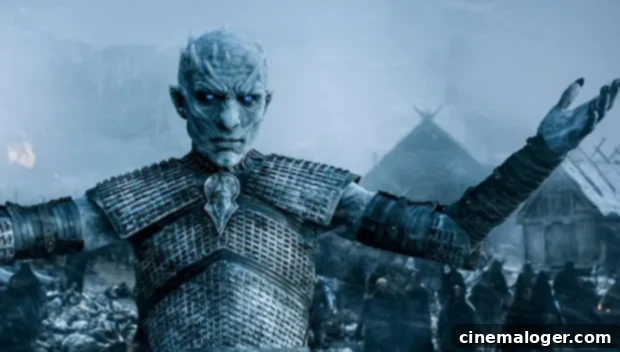
While some viewers took the theory at face value, pondering the existential implications of living within a giant’s ocular cavity, others sought more symbolic interpretations. One prominent fan theory, articulated by Reddit user mybustersword, offers a compelling alternative perspective. This interpretation shifts the focus from a literal giant to a metaphorical one, specifically linking the “blue-eyed giant” to the Night King. “I don’t believe the blue-eyed giant is something that literally holds all of Westeros,” the fan posited, suggesting instead that “the myth is another homage to the Night King.” This theory draws strength from the Night King’s undeniable visual impact and his central role in the later seasons. His piercing, icy blue eyes became an iconic symbol of the encroaching threat of the Long Night, heavily featured in Season 7’s promotional material, which often emphasized the chilling blue gaze of the White Walkers and their leader. The theory proposes that the name Macumber isn’t just a random name but could belong to the Night King, or at least represent his overarching presence and power. In this view, the Night King, through his command over the dead, essentially “sees” all of Westeros through the eyes of his vast army, making him the ultimate blue-eyed observer presiding over the realm.
The symbolic interpretation gains further traction when considering Old Nan’s prophetic abilities. If her tales about the White Walkers and the impending winter proved to be horrifyingly accurate, then perhaps her story of Macumber also held a kernel of truth, albeit one that required decoding. The Night King’s capacity to raise the fallen, transforming them into his own blue-eyed soldiers, metaphorically extends his vision and control across the continent. Every wight, every reanimated creature, becomes an extension of his will, contributing to his “sight” over the world. This perspective transforms a whimsical children’s story into a grim, overarching commentary on the true nature of the ultimate antagonist in Westeros. The idea that the Night King is the blue-eyed giant elevates his character beyond a mere villain to a more cosmic, almost god-like entity, whose watchful (and destructive) gaze encompasses all existence within his grasp.
A crucial detail that adds another layer of intrigue to the Blue-Eyed Giant theory is its absence from George R.R. Martin’s original A Song of Ice & Fire book series. The character of Macumber and the specific tale of living inside a giant’s eye appear to be an invention of the showrunners, D.B. Weiss and David Benioff. This divergence raises important questions: Was it merely a creative liberty, a unique touch added to the televised adaptation without deeper meaning? Or did the showrunners introduce it as a deliberate piece of foreshadowing, a subtle hint at the overarching narrative or a thematic concept they wished to explore? The fact that it was revisited suggests it wasn’t a one-off line. Its inclusion, and particularly its second mention, could be seen as a conscious effort to weave a unique layer of mystery and potential symbolism into the show’s lore, distinct from the books but harmonizing with its broader themes of fate, destiny, and the cyclical nature of conflict.
Ultimately, the Blue-Eyed Giant theory, whether interpreted literally or symbolically, served as a fascinating point of discussion for the passionate Game of Thrones fanbase. It encapsulated the show’s ability to blend high fantasy with grounded political drama, leaving room for both whimsical fables and profound, darker interpretations. Was it merely a charming fairy tale shared by Old Nan, meant to add flavor to the rich tapestry of Westerosi culture? Or was it a profound piece of foreshadowing, an enigmatic clue hinting at the true nature of the universe or the ultimate antagonist? Even as the final season brought closure (and controversy) to many storylines, the Macumber theory remained a testament to the show’s enduring capacity to spark imagination and critical thought. It stands as a vivid example of how even minor details, when placed within a sprawling epic, can ignite endless debate and profound reflection, long after the credits have rolled and the final battles have been fought. The captivating power of Game of Thrones lies not just in its intricate plots and memorable characters, but also in the fertile ground it provided for such imaginative and thought-provoking fan theories, enriching the viewing experience for millions worldwide.