GLOW Season 3 Uncovered: Jackie Tohn Dives Deep into Melrose’s Defining Moments, Intimacy, and Emotional Depth
[WARNING: SPOILERS AHEAD FOR ‘GLOW’ SEASON 3]
For any dedicated fan of Netflix’s critically acclaimed series GLOW, an interview with star Jackie Tohn is nothing short of a dream. Having embodied the vibrant, wild-child persona of Melrose since the show’s inception, complete with a heart of gold and a signature top rope cross-body maneuver, Jackie possesses an unparalleled treasure trove of behind-the-scenes anecdotes. As the series celebrated five well-deserved Emmy nominations, Jackie reflected on her journey, sharing, “It feels really good to be part of a thing that I recognize as a deeply, deeply rare occasion.” This sentiment perfectly encapsulates the magic of GLOW, a show that masterfully blends humor, athleticism, and profound emotional narratives. Ahead of the highly anticipated third season, we delved into what proved to be the most heartbreaking and hilarious installment yet, exploring how Jackie Tohn navigated Melrose’s significant emotional challenges.
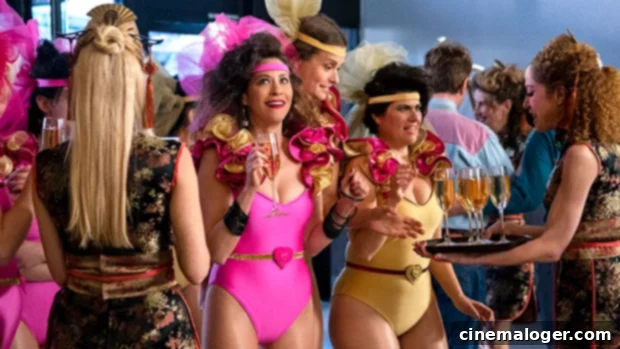
Season three transports the Gorgeous Ladies of Wrestling from the glitz of television production to the dazzling, yet often demanding, stage of Las Vegas. Following the cancellation of their TV show, the women find themselves regrouping as a live stage act on the iconic Strip. Their new environment introduces them to Sandy Devereaux St. Clair, portrayed by the incomparable Geena Davis, a shrewd casino director who monitors their success with a vigilant eye. Each character grapples with unexpected and life-altering changes, providing a rich tapestry of individual storylines. What truly sets GLOW’s third season apart from its predecessors is its dedicated focus on each woman’s personal journey. Rather than superficial, token episodes, viewers are treated to deep-dive narratives that organically unfold across the ten-episode arc, offering an intimate look into their lives both inside and outside the wrestling ring.
Melrose’s journey in Las Vegas kicks off with an intriguing entanglement: a relationship with a gigolo named Paul, played by Nick Clifford. Their initial encounter in the hotel bar quickly escalates, leading to Melrose’s room and a passionate encounter that famously features the show’s first full-frontal male nude scene. Jackie Tohn humorously recalled another groundbreaking moment from the scene: “And, it’s the first Melrose titty shot.” She revealed that the original script had Melrose putting her shirt back on, but her comedic instincts led to a last-minute change. “I thought it would be funnier if she didn’t and she was arguing, yelling, and fighting [topless]. I just was like, ‘Yeah, theatrically, as a comic, that’s a funnier joke. So, I got so comfortable that I game time decisioned it and changed it at the last second.'” This impromptu decision not only highlighted Melrose’s audacious personality but also underscored the comfort and trust fostered on the set, particularly concerning sensitive scenes. The ability to make such a bold artistic choice in the moment speaks volumes about the empowering environment cultivated behind the scenes.
Such groundbreaking moments, especially involving nudity and intimacy, would likely have been far more challenging without the invaluable presence of the show’s Intimacy Coordinator—a role Jackie genuinely reveres. She passionately explained how this coordinator transformed the process, making it not only safe but genuinely enjoyable for the actors. “I imagine this was very different from the movie making of years past,” Jackie observed, contrasting it with a bygone era where actors might face pressure and discomfort. “When it was like, ‘You’re doing a sex scene. You wanted a job as an actor or an actress. Take your tits out. We don’t really have time for this. There’s another girl waiting if you’re not comfortable with this.’ This was the opposite of that vibe. There was extra care, extra caution, extra comfort, and extra padding in between us to make sure nobody felt anybody else’s nether region and nobody was uncomfortable.” This emphasis on consent, boundaries, and emotional well-being represents a vital evolution in the industry, allowing actors to fully commit to their performances without compromising their personal comfort or safety.
Jackie delved into the meticulous and surprisingly intricate process of preparing for an intimate scene, often referred to as “getting dressed” for a sex scene. “I’m so happy we’re talking about this,” she exclaimed, eager to demystify what truly goes on when the cameras roll. She meticulously detailed the various items actors wear to ensure complete coverage, even when one actor, like Nick Clifford, is portrayed as fully nude. The extensive process includes several layers of protective gear. First, there’s a “NoToe,” designed to prevent any unintended riding up of fabric. Then comes moleskin, providing an additional layer of discretion and comfort. Next, a specially designed thong that “tapes to your front, so your butt is out,” maintaining the visual illusion while ensuring privacy. But Jackie’s absolute favorite invention, the pièce de résistance of on-set intimacy, is the “Vajoga.” (We indeed confirmed the spelling during our conversation, a testament to its unique and memorable nature.)
The “Vajoga” is a testament to the ingenuity and care involved in modern intimacy coordination. Jackie explained the brilliant design: “In between us, they cut a yoga mat into the shape of a bikini bottom with a cutout for your thighs and they put that between you and then they wrap that in a pillowcase.” This innovative piece of padding ensures a physical barrier, creating a safe space for actors during close physical scenes. She continued, illustrating the layering: “So, when he’s on top of me, there is a ‘vajoga’, a whale tail undie, a moleskin and a NoToe. That’s how the layering goes… A ‘vajoga’, Bro. Okay. You’re getting the tea today.” Her enthusiastic explanation truly brought to life the dedication to actor comfort and safety, transforming what could be an awkward scenario into a professional and well-managed experience. The revelation of the “Vajoga” was indeed a fascinating piece of insider information, offering a glimpse into the evolving practices that prioritize actors’ well-being in the industry.
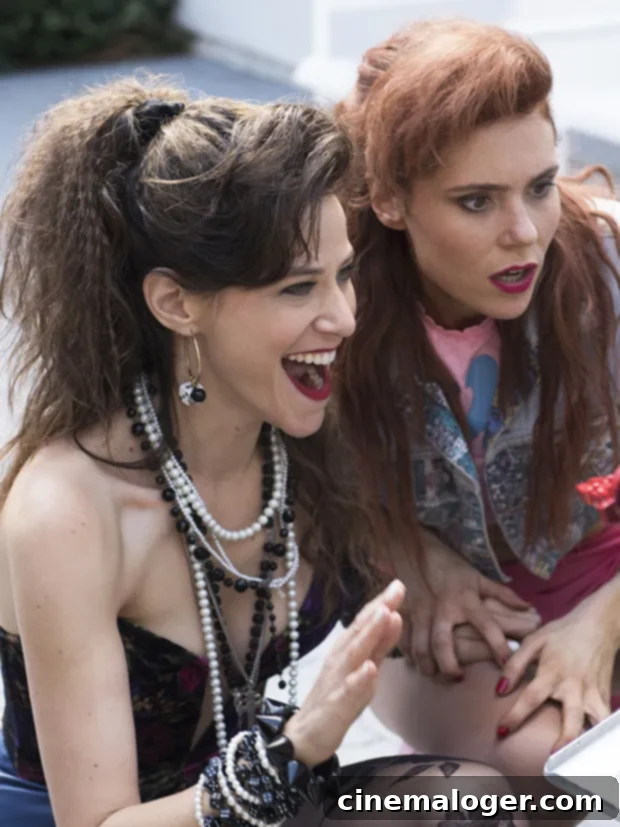
Beyond the fascinating details of intimacy coordination, Melrose’s romance with Paul deepens throughout the season. While his chosen profession initially intrigues Melrose, their relationship quickly becomes complicated as she develops genuine feelings for him. The narrative takes an even more convoluted turn when Melrose, perhaps innocently, suggests Paul’s services to her friend Rhonda (Kate Nash) in an attempt to spark jealousy in Rhonda’s new husband, Bash (Chris Lowell). This leads to an intense and emotionally charged threesome involving Rhonda, Bash, and Paul. By the season’s close, Melrose remains blissfully unaware of her friend’s ménage à trois with her boyfriend and husband. This looming secret promises to create significant dramatic tension should a fourth season materialize. Jackie believes this revelation would be profoundly impactful for Melrose, noting, “I think that’s going to be really dramatic for her. Because I feel like she finally found someone … She doesn’t judge Paul at all for doing what he does and he doesn’t judge her for doing any of her crazy antics. I think she finds a good thing with him.” She added a poignant insight into Melrose’s character when considering a potential Season 4, “If they do end up staying together, I think Melrose would be the type of person that would say like, ‘Oh, I don’t care, he can do whatever he wants as long as he comes home to me.’ But she doesn’t really feel that way.” This hints at a deeper emotional vulnerability beneath Melrose’s carefree exterior, suggesting a profound struggle with betrayal.
Indeed, Season 3 showcases Melrose’s remarkable evolution beyond a one-dimensional party girl. Halfway through the season, the show boldly tackles the traumatic family histories of Melrose and her best friend, Jenny. In a particularly memorable episode, the wrestlers playfully swap personas before a show. However, the lighthearted fun turns serious when Jenny becomes deeply upset by Melrose’s portrayal of “Fortune Cookie,” which Jenny perceives as mocking her culture. The tension carries over to a team camping trip in the desert, where Melrose desperately tries to apologize. Jackie confessed that her real-life discomfort mirrored Melrose’s, acknowledging the sensitive nature of the scene. “When I came in as Fortune Cookie and I was taking those little tiny, racist-ass steps — that’s what the script called for!,” she explained. “We were shooting with Geena Davis that day, and after I said every line, they would call cut, and I would just apologize to the crowd. And Geena was laughing at me so hard because she was like, ‘Oh my God, the shame you’re feeling right now is palpable.'” This candid reflection highlights the show’s willingness to confront difficult subjects and the actors’ commitment to authenticity.
When Melrose’s initial apologies fail to bridge the divide, Jenny withdraws further, prompting Melrose to try a different, more profound approach: bringing all the women together for a campfire Seder. It is during this powerful gathering that the narrative delves into truly raw and personal territory. Jackie visibly moved, shared her feelings when asked about preparing for the scene where Jenny and Melrose recount their families’ harrowing experiences with the Holocaust and the Cambodian genocide. “I have full body chills that the question is even being asked, because that means that this exists,” she stated, underscoring the weight and significance of the storyline.
Jackie elaborated on the personal connection she shares with Ellen Wong, who portrays Jenny. “With me and Ellen, we realized, I think in the middle of season one at a Passover Seder — or we were talking about having a Passover Seders because Ellen’s married to a Jewish guy and she’s Cambodian — we were talking about the Cambodian genocide and I didn’t know, of course, anything about it,” she explained. Ellen revealed that her own parents were survivors of the Cambodian genocide. “Then, we were talking about the gross similarities to the Holocaust, which my grandparents survived. They were able to give birth to my mom, who was able to give birth to me, which makes me a second-generation Holocaust survivor.” This deeply personal revelation between the actors clearly resonated with the show’s writers, forging an incredibly powerful and authentic narrative thread.
“It’s just crazy,” Jackie continued, reflecting on the writers’ decision to weave their personal histories into the show. “And we were telling Sasha, one of our writers, about that and they were like, ‘That’s an amazing connecting line for Melrose and Jenny.’ And that’s crazy in and of itself; that our writers see us and they don’t shy away from these gnarly topics like the Cambodian genocide, which nobody talks about, and the Holocaust, which people do talk about here and there, but also it’s a long time ago already. It’s sort of becoming a thing of the past, thank God, but also gross similarities to things that are still very much going on in the world.” This profound storyline not only gives voice to underrepresented historical traumas but also highlights the enduring relevance of these events in contemporary society, demonstrating GLOW’s capacity for powerful social commentary.
Ultimately, the shared pain and profound understanding forged through this conversation reunite the women, restoring peace and fostering a deeper appreciation for each other’s personal histories and identities. This storyline offers the audience a significantly deeper level of engagement with the show, and Jackie herself admitted to gaining a renewed appreciation for GLOW after this particular arc. “On the one hand, it’s just incredible that they’re willing to tackle these subjects,” she said, applauding the show’s courageous storytelling. “Then personally, that I get to be the actor that’s telling these stories that are this close to my heart and lineage and family. It’s really spectacular.” This convergence of personal history with powerful fictional narrative exemplifies the unique strength and emotional resonance of GLOW, solidifying its place as a groundbreaking series that transcends mere entertainment to explore the depths of human experience.
GLOW season three premiered on Netflix on Friday, August 9, 2019.