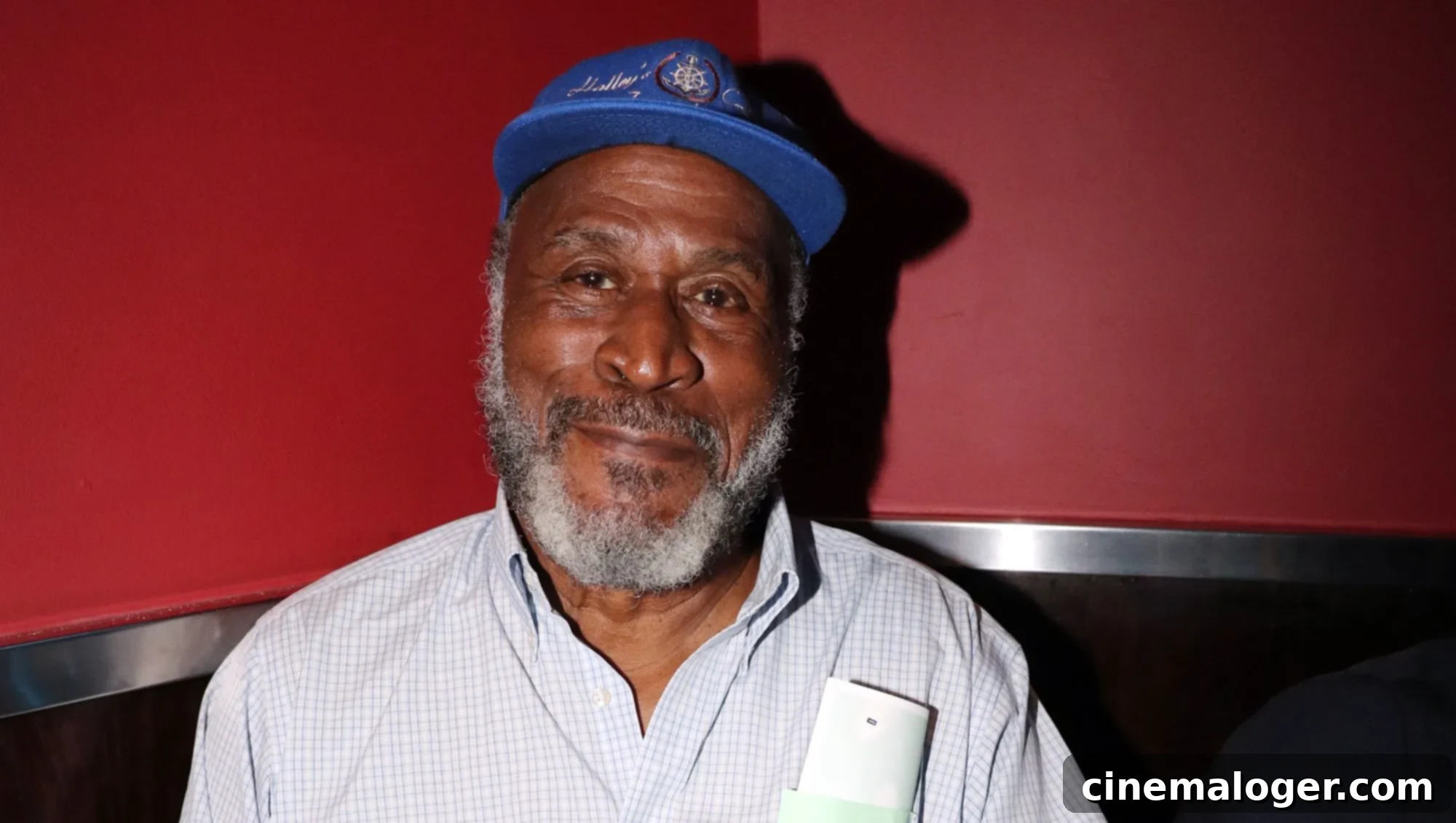
John Amos: Celebrating a Legendary Actor’s Enduring Legacy in Film and Television
The entertainment world mourns the loss of John Amos, a revered actor whose career spanned over five decades, leaving an indelible mark on both television and film. Best known for his iconic portrayal of the steadfast family patriarch, James Evans Sr., on the groundbreaking 1970s sitcom Good Times, Amos also earned critical acclaim and an Emmy nomination for his powerful role in the seminal 1977 miniseries Roots. His journey from professional football player to celebrated actor underscores a life dedicated to impactful storytelling and a commitment to authentic representation.
John Amos passed away on August 21 at the age of 84 in Los Angeles due to natural causes, as confirmed by his representative. His passing marked the end of an era for many who grew up watching his versatile performances and admired his dedication to his craft. A statement released after his death eloquently summarized his profound impact: “With a career spanning over five decades, Amos leaves behind a legacy of groundbreaking work in both television and film, along with a commitment to positive African American representation in media.” This commitment was a hallmark of his career, influencing countless viewers and paving the way for future generations of Black actors and storytellers.
The Enduring Legacy of James Evans Sr. on Good Times
For millions, John Amos will forever be synonymous with James Evans Sr., the hardworking, principled father on Good Times. Set in the Chicago projects, the show broke new ground by depicting the daily struggles and triumphs of an African American family with humor, dignity, and realism. As James Evans, Amos embodied a character striving against formidable odds to provide for his family, emphasizing education, strong family values, and unwavering integrity in the face of systemic challenges. His portrayal offered a powerful counter-narrative to often stereotypical depictions of Black men on television at the time, establishing James Evans Sr. as one of the first truly positive and complex African American fathers in mainstream media.
The show, a spin-off of Maude, resonated deeply with audiences for its honest portrayal of urban life and the universal themes of family love and resilience. Amos’s commanding presence and heartfelt performance made James Evans a beloved figure, an aspirational role model for many. His character’s dedication to keeping his family together, despite economic hardship, cemented him as a pillar of strength and wisdom. While Good Times often tackled serious social issues, Amos’s warmth and humor ensured the show remained accessible and uplifting, showcasing the joy and camaraderie within the Evans household even amidst adversity. His nuanced acting brought a depth to the character that transcended the sitcom format, leaving a lasting cultural imprint.
However, Amos’s time on Good Times was not without its complexities. He famously departed the show after the third season due to creative differences with the producers, expressing concerns over the increasingly comedic and at times stereotypical direction of his character and the show as a whole. He sought to maintain the integrity and dignity of James Evans Sr., believing the portrayal of a strong Black family was paramount. This decision, though controversial at the time, further highlighted his commitment to authentic representation and his refusal to compromise on his artistic principles, cementing his legacy not just as an actor, but as an advocate for meaningful storytelling.
A Powerful Performance in Roots: Toby’s Journey
Beyond the laughs and warmth of Good Times, John Amos demonstrated his dramatic prowess in the groundbreaking 1977 miniseries Roots. Based on Alex Haley’s novel, Roots traced the ancestry of an African American family from the 18th century through the American Civil War. Amos delivered a compelling performance as Toby, a slave on a Virginia plantation. His portrayal was both poignant and powerful, capturing the immense suffering, resilience, and quiet dignity of an enslaved man struggling for freedom and survival.
The miniseries was a cultural phenomenon, watched by an estimated 130 million people, and it fundamentally altered the way American history and the institution of slavery were depicted on screen. Amos’s contribution to this monumental production was recognized with a Primetime Emmy nomination for Outstanding Lead Actor in a Single Performance in a Drama or Comedy Series. His ability to shift from the comedic timing required for Good Times to the profound emotional depth demanded by Roots showcased his extraordinary versatility and confirmed his status as an actor of immense talent. The role of Toby allowed him to further champion the cause of authentic African American narratives, demonstrating the power of storytelling to educate, enlighten, and inspire.
From Gridiron to Silver Screen: An Unconventional Path
Born on December 27, 1939, in Newark, New Jersey, John Amos’s early life revealed a man of diverse talents and intellectual curiosity. Growing up in a family that deeply valued education, he also excelled as a talented athlete. His prowess in football earned him a scholarship to Long Beach State University, though he initially enrolled at Long Beach City College. He later graduated from Colorado State University with a degree in sociology, qualifying him as a social worker. This academic background, coupled with his innate empathy, likely informed the depth and understanding he brought to many of his characters.
Before his acting career took off, Amos pursued his athletic dreams, playing college football at Colorado State. His journey even included a brief stint in professional football, joining the Kansas City Chiefs for the 1967 NFL offseason. This period of his life, though short-lived in professional sports, instilled in him discipline, resilience, and a competitive spirit—qualities that undoubtedly served him well in the demanding world of acting. His transition from the physical rigor of the football field to the emotional demands of the stage and screen was unconventional, yet it spoke volumes about his determination to follow his passions and explore different avenues of expression.
Diverse Beginnings: Stage and Early Television Roles
John Amos’s foundation in the performing arts was solidly built on the stage. He began his career in theater, performing in various productions, including a notable run in the Broadway hit musical Hair. This early exposure to live theater honed his craft, developing his voice, stage presence, and ability to connect directly with an audience. His theatrical work extended to acclaimed productions like The Negro Ensemble Company’s The Great MacDaddy, further showcasing his commitment to impactful and culturally significant storytelling. These formative years in regional and national theater provided him with a strong understanding of dramatic structure and character development, essential tools he would later bring to his television and film roles.
His transition to television brought him his first major role as Gordy Howard, the weatherman on The Mary Tyler Moore Show from 1970 to 1973. As the only Black character on the show at the time, Amos brought a calm and understated humor to his role, often playing the straight man to the bombastic and comically inept anchor, Ted Baxter. Gordy Howard was a dignified and intelligent character, another early example of Amos’s subtle yet powerful influence in diversifying television representation. This role not only introduced him to a wider audience but also demonstrated his versatility, proving he could shine in ensemble casts and bring depth to seemingly minor characters, setting the stage for his subsequent iconic roles.
Beyond Sitcoms: Versatility in Film and Drama
While Good Times and Roots solidified his status as a household name, John Amos’s career was characterized by remarkable versatility across a wide array of film and television projects. He refused to be typecast, constantly seeking out diverse roles that challenged him and allowed him to showcase different facets of his talent. In film, he delivered memorable performances in blockbusters such as the romantic comedy Coming to America (1988), where he played Cleo McDowell, the owner of McDowell’s fast-food restaurant and the father of Eddie Murphy’s love interest. His portrayal was both humorous and endearing, adding a layer of grounded reality to the fantastical premise.
Amos also ventured into action films, notably appearing in Die Hard 2 (1990) as Major Grant, a role that demonstrated his ability to command authority and intensity. His filmography also includes the animated classic The Black Cauldron (1985), where he lent his distinctive voice, further proving his range. On television, his post-Good Times career was equally robust. He appeared in critically acclaimed series like The West Wing, portraying Admiral Percy Fitzwallace, the Chairman of the Joint Chiefs of Staff, a role that once again allowed him to embody wisdom, gravitas, and leadership. He also had recurring roles in popular shows such as Men in Trees and guest-starred in numerous others, including The Cosby Show, Two and a Half Men, and Miami Vice, showcasing his enduring presence and adaptability in an ever-evolving industry. Each role, whether major or minor, was approached with the same dedication and professionalism that defined his illustrious career.
A Champion of Authentic Representation
Throughout his extensive career, John Amos was not merely an actor; he was an advocate. His commitment to positive African American representation in media was a guiding principle, evident in his choice of roles and his willingness to speak out against stereotypical portrayals. He understood the profound impact that television and film could have on public perception and self-image, particularly for minority communities. By portraying characters like James Evans Sr. and Toby with such depth and integrity, he actively worked to dismantle harmful tropes and promote a more nuanced understanding of Black experiences.
His dedication extended beyond the screen. Amos was known for his thoughtful engagement on issues concerning racial equality and social justice. He championed narratives that celebrated Black strength, resilience, and humanity, leaving an important legacy for diversity in Hollywood. His career served as a testament to the power of representation, demonstrating how one actor’s commitment could significantly contribute to shaping cultural narratives and fostering a more inclusive media landscape. His work helped to open doors and create opportunities for future generations, inspiring countless individuals within and outside the entertainment industry.
Accolades and Recognition: A Career Honored
John Amos’s contributions to the arts did not go unnoticed, earning him numerous nominations and awards throughout his distinguished career. His impactful performances garnered recognition from prestigious organizations, celebrating his talent and influence. Among his accolades were multiple NAACP Image Award nominations, which honor outstanding performances by people of color in film, television, music, and literature. As previously mentioned, his powerful portrayal in Roots earned him a coveted Primetime Emmy Award nomination for Outstanding Lead Actor, a testament to his dramatic range and the profound impact of his work on the series.
He also received special recognition for his iconic television roles, including the TV Land Groundbreaking Show Award for The Mary Tyler Moore Show, acknowledging its pioneering influence. For his role in Good Times, he was honored with the TV Land Impact Icon Award, celebrating the show’s lasting cultural significance and his pivotal contribution. Furthermore, he received the TV Land Anniversary Award for Roots, commemorating the enduring legacy of the miniseries. In 2020, his significant contributions to his home state were recognized with his induction into the New Jersey Hall of Fame, a fitting tribute to a native son who achieved national and international acclaim. Earlier in his life, Amos also proudly served in the New Jersey National Guard, further highlighting his commitment to service.
Personal Life and Family Values
Beyond the bright lights of Hollywood, John Amos led a life rooted in family. He was married twice and was a proud father to two children. His daughter, Shannon, was born in New Jersey in 1966 to Amos and Noel J. Mickelson, his first wife. Four years later, in 1970, their second child, Kelly Christopher, affectionately known as “K.C.,” was born. Family remained a significant aspect of his life, aligning with the values he often portrayed in his most famous roles. His dedication to his children was a constant, and he often spoke of the importance of providing them with a strong foundation.
After Amos and Mickelson divorced in 1975, he briefly married actress Lillian Lehman. While details about their relationship largely remained private, his personal life, much like his professional career, reflected a journey of diverse experiences and connections. He maintained a close bond with his children, and they often shared stories of his guidance and love. His personal commitment to family mirrored the powerful, albeit fictional, patriarch he brought to life on screen, leaving a complete picture of a man dedicated to both his craft and his loved ones.
John Amos’s passing leaves a void in the entertainment industry, but his legacy continues to shine brightly. From the gridiron to Broadway, from the vibrant streets of the Chicago projects to the harrowing plantations of Virginia, Amos’s journey was one of unwavering dedication, profound talent, and a deep commitment to positive representation. He was more than an actor; he was a cultural icon, a voice for authenticity, and a trailblazer who enriched the lives of millions through his memorable performances and his enduring impact on American media. His work will continue to inspire, entertain, and educate for generations to come, ensuring that the legacy of John Amos will never be forgotten.