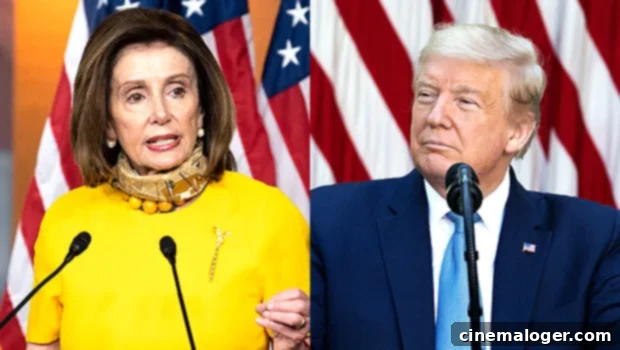
Nancy Pelosi Clashes with Donald Trump: Decorum, Health Concerns, and “Morbidly Obese” Remarks Amid COVID-19 Crisis
The political landscape in Washington D.C. was intensely charged during the global COVID-19 pandemic, and House Speaker Nancy Pelosi, 80, frequently found herself at odds with then-President Donald Trump. While the week commenced with Pelosi drawing attention for her direct description of Donald Trump as “morbidly obese,” a phrase that immediately sparked widespread debate, her criticisms escalated significantly during a press conference focused on the nation’s COVID-19 response on May 20, 2020. Far from merely reiterating short jabs, Pelosi embarked on a comprehensive rebuke of the President’s conduct when a reporter shifted the discussion to a highly sensitive topic: “Is it appropriate of the president to accuse a TV host of murder on Twitter?”
This pointed question referred to a series of controversial tweets by President Trump earlier in May, targeting former Florida Republican congressman and current *Morning Joe* MSNBC anchor, Joe Scarborough. The President had taken to social media on May 12 to write, “When will they open a Cold Case on the Psycho Joe Scarborough matter in Florida. Did he get away with murder? Some people think so.” This tweet, which gained significant traction and condemnation, referenced the tragic death of Lori Klausutis, an intern in Scarborough’s congressional office in 2001. Despite a medical examiner officially ruling Klausutis’s death an accidental fall due to an undiagnosed heart condition, and police findings supporting this conclusion, Trump repeatedly propagated baseless accusations, sowing doubt and pain for the Klausutis family. The family had, in fact, publicly pleaded with Twitter to remove the President’s tweets, citing the immense distress they caused.
Pelosi did not mince words in her response to the reporter’s inquiry about the appropriateness of Trump’s actions. “You’re asking me about the appropriateness of the actions of this president of the United States? So completely inappropriate in so many ways that it’s almost a given,” Pelosi stated, emphasizing the apparent nature of the President’s perceived transgressions. Her exasperation was palpable as she struggled to find an adequate comparison for behavior she deemed so far outside the bounds of presidential decorum. In an analogy that resonated widely, Pelosi likened Trump’s actions to those of a misbehaving child, a comparison that had become increasingly common in political discourse during those contentious weeks.
“It’s like a child who comes in with mud on their pants or something — that’s the way it is, they’re outside playing,” Pelosi elaborated, painting a picture of innocent, albeit messy, youthful antics. However, she quickly escalated the metaphor to reflect a deeper, more pervasive problem. “He comes in with doggy doo on his shoes and everybody who works with him has that on their shoes, too, for a very long time to come,” she added, making her profound disapproval of Trump’s conduct unequivocally clear. This vivid image conveyed not just the immediate inappropriateness of the President’s statements but also the lasting negative impact and reputational stain it inflicted upon his administration and those associated with him, suggesting a widespread compromise of ethical standards.
Pelosi further asserted that her concerns about the President’s behavior were echoed by medical professionals she had encountered. “I hear doctors talk to me about saying, ‘What’s matter with him?’ The things he says are so inappropriate for a president of the United States,” Pelosi continued, lending an air of professional medical concern to her political critique. She then introduced a specific psychological term that, she claimed, had been suggested to her by an expert to better understand Trump’s communication style. “There’s a word somebody used to me. They said you would understand it better if you knew what a confabulator is — look up the word confabulator — someone who just really doesn’t even know what the truth is. And just says anything. And because he says it, then he believes it.”
For context, a “confabulator” is a person who unknowingly replaces gaps in their memory with distorted or fabricated memories, which they genuinely believe to be true. This condition is often associated with certain neurological disorders, and Pelosi’s use of the term, whether literally intended or as a metaphorical descriptor, was a potent psychological jab. It implied a fundamental detachment from reality and an inability to distinguish fact from fiction, portraying the President as a figure whose pronouncements were not merely misinformed but rooted in a self-serving, albeit unconscious, disregard for objective truth. Such a characterization, coming from a leading political figure, underscored profound concerns about presidential leadership, particularly during a public health crisis where accurate and consistent information was paramount.
Nancy Pelosi said President Trump is like a child “with doggy doo on his shoes” and that doctors have asked her, “What is the matter with him?” https://t.co/jZgfeFKUF2 pic.twitter.com/Lh92kELgDc
— CBS News (@CBSNews) May 20, 2020
Beyond her condemnation of the President’s comments on Joe Scarborough, Pelosi also took the opportunity to defend her earlier decision to publicly call Trump “morbidly obese” during an interview with Anderson Cooper on CNN on May 18. This specific comment had drawn significant media attention and criticism, with some labeling it as an inappropriate personal attack. Pelosi, however, presented a nuanced defense, framing her remark as a medical observation made out of genuine concern for the President’s health, particularly in the context of the ongoing pandemic. Her worries stemmed from reports that President Trump was taking hydroxychloroquine, an anti-malarial drug, as a preventative measure against COVID-19, despite widespread medical warnings.
The Food and Drug Administration (FDA) had, at the time, specifically advised against the use of hydroxychloroquine for the prevention or treatment of COVID-19 outside of a hospital setting or clinical trial, citing potential serious heart rhythm problems and other severe side effects. This warning was particularly pertinent for individuals with pre-existing health conditions or those in certain “weight groups.” Pelosi emphasized that given Trump’s reported weight and age, she was genuinely concerned about his use of a potentially dangerous, unproven drug. She stated, “I was only quoting what doctors had said about him, so I was being factual in a very sympathetic way.” This framing positioned her comment not as an insult, but as a factual and medically informed expression of concern for a high-risk individual during a public health emergency.
Furthermore, Pelosi offered a political rationale for her bluntness, suggesting she was merely giving Trump “a dose of his own medicine.” She explained this perspective to a reporter, stating, “He’s called women one thing or another over time, and I thought he thinks that passes off as humor in certain cultures.” This was a clear reference to President Trump’s well-documented history of making disparaging remarks about women’s appearances, including their weight and physical attributes. Throughout his public life and political career, Trump had frequently used terms like “nasty woman” and had made comments widely perceived as misogynistic and body-shaming. Pelosi’s retaliatory “morbidly obese” comment, therefore, served as a direct mirroring of the kind of personal attacks Trump himself had often deployed, aiming to highlight the hypocrisy and double standards he often exhibited.
The exchange underscored the highly personal and often acrimonious nature of the political rivalry between Pelosi and Trump. While Pelosi framed her remarks as both a medically-driven concern and a strategic counter-attack against Trump’s own rhetorical style, the President predictably did not take kindly to her comments about his weight. In a press conference held on May 19, the day after Pelosi’s CNN interview, Trump quickly retorted, characteristically turning the criticism back on his adversary. “Pelosi is a sick woman. She’s got a lot of problems — a lot of mental problems,” he declared, dismissing her concerns and launching a personal attack of his own. This response mirrored his frequent strategy of undermining critics by questioning their mental stability or accusing them of being “sick,” a tactic often used to deflect from the substance of the critique.
These escalating rhetorical battles during the peak of the COVID-19 crisis illustrated the deep chasm in American political leadership and communication. Instead of a unified front against a global pandemic, the public witnessed a contentious exchange marked by personal attacks, questions of decorum, and conflicting narratives about truth and responsibility. Pelosi’s criticisms of Trump, ranging from his unfounded accusations against Joe Scarborough to her “morbidly obese” observation, highlighted fundamental concerns about presidential conduct, honesty, and leadership during a national emergency. Her analogies and psychological references were not merely insults but attempts to articulate a perceived deficiency in the President’s character and fitness for office, especially when faced with the unprecedented challenges of COVID-19. The back-and-forth, while providing ample fodder for political commentary, ultimately underscored the profound polarization and distrust that characterized American politics during one of its most challenging periods.