Donald Trump Indictment: First Public Document Released in Stormy Daniels Hush Money Case
In a landmark moment for American legal and political history, the first official document directly acknowledging the indictment of Donald Trump was released to the public on Friday night, March 31. This unprecedented disclosure related to the alleged hush-money payment to adult film star Stormy Daniels provided concrete, public confirmation of a grand jury’s decision to charge the former President, concluding days of intense speculation and media frenzy.
The significant document unveiled was an order from Justice Juan Merchan, the presiding judge overseeing the case. This judicial decree granted essential permission to Manhattan District Attorney Alvin Bragg to issue a public statement. This statement would not only acknowledge the former President’s indictment but also confirm that Bragg’s office was actively engaged in coordinating Trump’s surrender to authorities for his upcoming arraignment. Such an order is crucial in high-profile cases, especially those involving grand jury proceedings, which are typically shrouded in secrecy to protect the integrity of the investigation and the privacy of those involved until formal charges are presented in open court. This judicial authorization was the initial step in making parts of the closely guarded legal process transparent to the public. Frank G. Runyeon, a former journalist for *The New York Times*, swiftly shared an image of this pivotal document on his Twitter account, captioning it, “This is the first document showing the existence of the indictment of the former president.” His post immediately amplified the news, providing tangible evidence of the legal developments to a wide audience.
NEW: Order from Justice Merchan allowing @ManhattanDA to disclose the existence of the indictment of Donald Trump. @Law360
This is the first document showing the existence of the indictment of the former president. pic.twitter.com/ut7d7U95xH
— Frank G. Runyeon (@frankrunyeon) March 31, 2023
This judicial order was, in essence, a crucial green light from the bench, authorizing District Attorney Bragg to publicly disclose that a grand jury had returned “a true bill” against the former President. A “true bill” is a formal declaration by a grand jury indicating that it has found sufficient probable cause to believe that a criminal offense has been committed and that the accused person should proceed to trial. This legal step solidifies the indictment, moving the case from grand jury investigation to formal prosecution. As *The Washington Post* highlighted, this document was the essential “blessing” Bragg needed to make his public announcements regarding the alleged hush money payment to Stormy Daniels. While the order confirmed the existence of the indictment, it did not, however, delve into the specifics of the charges themselves. The details of the allegations against Trump, including the exact counts and legal statutes, remained sealed. This practice is standard until the defendant’s arraignment, ensuring that the charges are first formally presented in court and the defendant has the opportunity to enter a plea, thereby maintaining the fairness of the legal process.
The arraignment, which is the initial formal appearance of a criminal defendant in court, was widely expected to take place on Tuesday, as reported by NBC News. It was anticipated that the former Commander-in-Chief would voluntarily surrender himself to the Manhattan D.A.’s office for this proceeding. A spokesperson for the District Attorney’s office confirmed these arrangements, noting, “This evening we contacted Mr. Trump’s attorney to coordinate his surrender to the Manhattan D.A.’s Office for arraignment on a [New York] Supreme Court indictment, which remains under seal.” The spokesperson further added, “Guidance will be provided when the arraignment date is selected.” During the arraignment, Trump would formally be informed of the charges against him and would be given the opportunity to enter a plea (typically “not guilty” at this stage). This event would lift the veil of secrecy, making the specific legal accusations against him public for the first time, marking a significant juncture in the unprecedented prosecution of a former U.S. President.
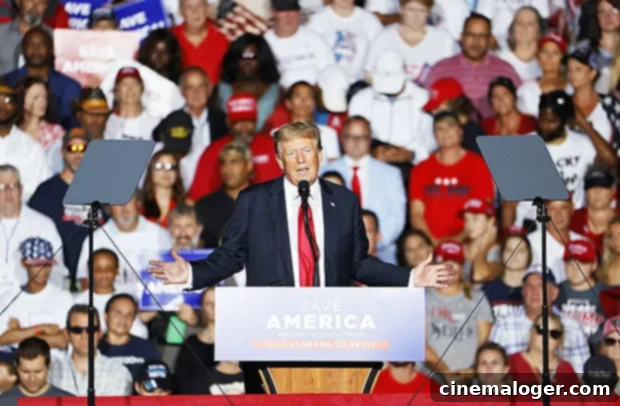
The news of Trump’s indictment, which initially broke on Thursday, prompted an immediate and vociferous response from the 76-year-old former President. Utilizing his own social media platform, Truth Social, Trump launched a strong critique, framing the legal action as a politically motivated attack. He wrote, “These Thugs and Radical Left Monsters have just INDICATED [sic] the 45th President of the United States of America, and the leading Republican candidate, by far, for the 2024 Nomination for President.” His statement continued with escalating rhetoric, asserting, “THIS IS AN ATTACK ON OUR COUNTRY THE LIKES OF WHICH HAS NEVER BEEN SEEN BEFORE. IT IS LIKEWISE A CONTINUING ATTACK ON OUR ONCE FREE AND FAIR ELECTIONS. THE USA IS NOW A THIRD WORLD NATION, A NATION IN SERIOUS DECLINE. SO SAD!” This forceful reaction underscored his consistent narrative of political persecution and positioned the indictment as a direct assault not just on him personally, but on the fabric of American democracy itself.
Trump’s impassioned social media rant arrived approximately two weeks after he had publicly declared his expectation of being arrested, a claim that preceded the official grand jury vote and added to the swirling speculation. While he did not specify the exact reasons for his anticipated arrest at the time, the underlying investigation had long been understood to revolve around a $130,000 payment made to Stormy Daniels. This payment was allegedly orchestrated to ensure Daniels would remain silent about her alleged affair with Trump during his 2016 presidential campaign, with the clear intention of preventing any negative impact on his electoral prospects.
The payment to Daniels was facilitated by Michael Cohen, who at the time served as Trump’s personal attorney and fixer. Cohen, who later became a key cooperating witness for the prosecution after his own legal troubles, testified that he made this payment on the direct instructions of Donald Trump, with an understanding that he would be reimbursed. The core of the legal controversy centers on the subsequent reimbursement process and how it was accounted for in Trump Organization records. Prosecutors allege that these reimbursements were deceptively disguised as “legal fees,” constituting falsification of business records. Under New York state law, falsifying business records can be elevated to a felony if it is done with the intent to commit or conceal another crime. In this specific case, the “other crime” is widely believed to be a violation of campaign finance laws. The argument is that the payment to Daniels, made during the critical 2016 election period to influence its outcome, should have been declared as a campaign expenditure, and its concealment constituted an illegal campaign donation. This intricate legal argument, central to the prosecution’s case, was meticulously reported by The New York Times and other major news outlets, emphasizing the serious nature of converting what might appear to be a simple repayment into a felony charge linked to election integrity.
This indictment represents an unprecedented and historic juncture in American jurisprudence, marking the first instance a former U.S. President has faced criminal charges. The implications of this case are vast, touching upon fundamental questions of accountability, the rule of law, and the integrity of the electoral process. The proceedings have sparked fervent national debate, polarizing public opinion and drawing intense scrutiny from legal scholars, political analysts, and citizens alike. Supporters of Donald Trump have largely condemned the indictment as a politically motivated “witch hunt” aimed at undermining his political future, particularly his bid for the 2024 Republican presidential nomination. Conversely, critics view it as a necessary demonstration that no individual, regardless of their past office, is above the law. Legal experts are closely analyzing every facet of the case, from the nuanced application of New York’s business records statutes to the challenges of proving criminal intent, and the potential far-reaching precedents this case could set for future political figures. The initial release of Justice Merchan’s order, allowing for public acknowledgment of the indictment, served as the formal opening chapter in what promises to be a protracted, closely watched, and profoundly impactful legal saga for the United States.